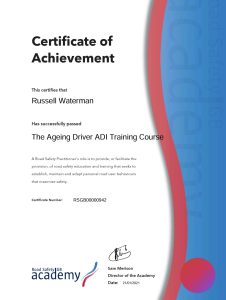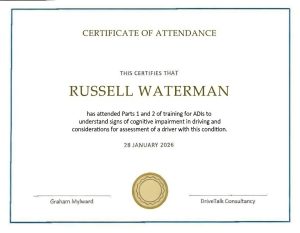

If you’re reading this, then you’re more than likely already concerned about a relative’s driving.
You’ve tried talking to them about their driving, but frustratingly they’re being stubborn about even discussing it and are more likely to listen to a driving professional.
THE ISSUES
Ageing causes a loss of peripheral vision. Our visual field decreases by one to three degrees per decade. By the time you reach your 70s and 80s, you may have a peripheral visual field loss of 20 to 30 degrees.
Cataracts make headlights appear overly bright, blurry, or surrounded by halos or starbursts, significantly impacting night driving safety due to glare and reduced contrast, as the clouded eye lens scatters light. This glare, along with faded colours (e.g. recognising the colours of lights on the back of vehicles, day or night) and misty vision, are key symptoms of cataracts.
Diabetes significantly impacts eyesight, primarily where high blood sugar damages the retina’s blood vessels, leading to blurry vision, floaters, or vision loss, but can also cause temporary blurriness from fluid shifts or cataracts to develop sooner.
There are also the issues for older drivers of reaction times slowing and cognitive problems, often caused by dementia.
Dementia can cause:
- Cognitive Decline: Affects memory, attention, concentration, problem-solving, and judgment.
- Visuospatial Issues: Difficulty with navigation, recognizing signs, judging distances/speeds.
- Psychomotor Skills: Slower reaction times, poor hand-eye or foot-eye coordination.
- Insight & Denial: May not recognize their own driving is dangerous, making it hard for them to stop driving voluntarily.
THE SOLUTION
Older drivers need to make self-adjustments, so they can keep driving safely for as long as possible, and be honest enough with themselves to know when it’s time to stop. I can help older drivers start to make these changes now (or agree it’s time to give you the car keys and get the Uber app).
Please book an initial 2hr assessment below. This will be about half driving (in the client’s car or mine) and half discussion.
CANCELLATION POLICY:
If you cancel or rearrange part or all of a driving lesson with less than 48 hours notice, You will still be liable to pay 100% of the lesson.
You must report medical conditions that may affect your driving to the DVLA